Raid and search of 42 Acacia Drive
The IPCRESS FileThe Raid and search of 42 Acacia Drive is a covert operation led by the Unnamed narrator after a police constable identifies an unusually secluded, recently altered house as a possible hiding place. The entry yields no occupants, but the search exposes a property fitted out in ways that contrast sharply with its ordinary domestic rooms: restricted telephone access, blank filing cards, concealed upper chambers, and a water tank containing parts of a tape recorder and a harness. Its decisive turn is from a street-level hunch to the discovery of a carefully adapted interior, without resolving who had used it or where they had gone.
Lead and target
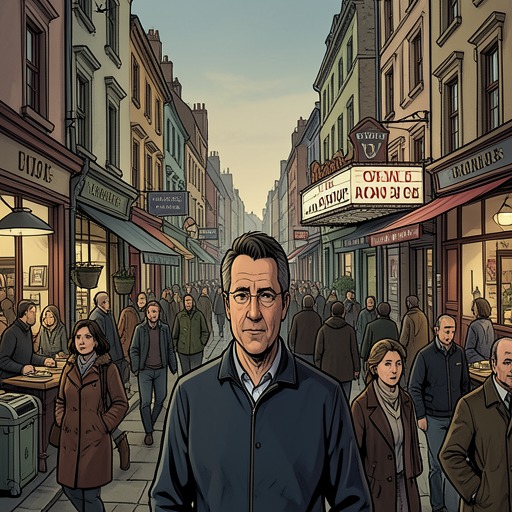
The inquiry begins with surveillance material showing Jay walking through a crowd and, in other films, accompanied by Housemartin. The footage was filmed covertly from a van and assembled under the title JAY. LEEDS. WARREN THREE. Housemartin appears as a tall, well-dressed man, identifiable by his camel-hair overcoat, jewellery, and conspicuous smile. The films give the investigators images of the people they are trying to locate, but no certainty that they will leave usable fingerprints or appear in ordinary police records.
At Shoreditch Police Station, the Unnamed narrator directs checks of fingerprints and Identikit descriptions for the two men. He considers a positive identification unlikely, given Jay’s arrangements, though a constable recognizes Housemartin from a photograph previously seen at the Criminal Records Office. The narrator then asks PC Viney to mark the relevant location on a map and seeks a private, preferably scrambled telephone line. The investigation is becoming an operation with security requirements, not simply a local police search.
Viney’s account supplies the lead. The narrator asks him to think of a house where new tenants have arrived within six months, unfamiliar people have been seen coming and going, and a driver might enter directly from a garage. Viney points to a property whose owner has bought the undeveloped sites on both sides, leaving it especially secluded. The neighbouring houses have identifiable occupants, but he cannot recall who lives at this one. It had undergone substantial building work, apparently a conversion into flats, around February; there are no visible letting notices. The combination of privacy, alterations, and unexplained occupancy makes number 42 the target, though it remains a reasoned suspicion rather than a confirmed identification.
Planning and approach
The Unnamed narrator requests thirty officers, at least five armed, and four vehicles without police identification. He specifies a radio-linked car for instructions en route, hook ladders, a jemmy, and a press blackout. When told that the plain vehicles are kept at Richmond, he tells the security officer to borrow private cars from police stations instead. The exchange establishes both the urgency of the task and the need to conceal its scale and purpose. The narrator warns that any leakage from the operation could be actionable under the Official Secrets Act.
Murray has already developed a practical assault plan. Using a photograph of the street, he draws a diagram of its walls and positions twenty-five men; the narrator then adds five more. Murray’s confidence in directing the local police is striking enough that the narrator privately decides to recheck his security clearance the next day. At 8.21, a military police vehicle arrives in the station courtyard at Murray’s request. It can carry radio equipment and, by arriving inside rather than parking conspicuously outside, attracts less attention. The vehicle also brings a revolver and ammunition, along with other useful equipment. The planning thus joins ordinary police resources to military support while trying to keep both the deployment and its authority out of public view.
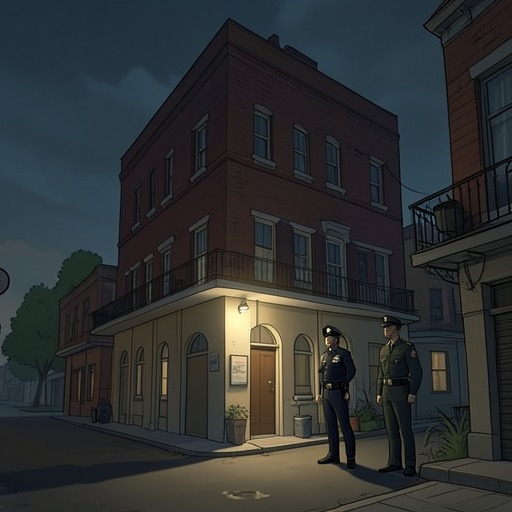
Acacia Drive is a wide, wet suburban street at the edge of London. Soot-dark hedges and weak streetlights frame the houses; during the wait, a man checks the covers on a row of cars and drives away in the one with the right number plate. At number 42, two gates open onto a semicircular gravel drive, and a small upper-floor window is lit. The Champ vehicle is positioned closer to the house than the private cars. From its back seat, a military policeman monitors radio traffic from plainclothes officers taking positions in the rear garden. The narrator and Murray choose a side window as their entry point.
Entry into an empty house
At about 9.11, the narrator and Murray cross the wet grounds toward the side of the house. The approach passes a greenhouse and a kitchen garden; the narrator’s feet are soaked, and the house seems to shift between the appearance of a threatening hideout and that of an ordinary home about to be raided. Murray touches his elbow with the cold jemmy, a small signal that it is time to act. Because the window is higher than expected, the narrator presses a sheet of brown paper coated with golden syrup against the glass. Murray strikes the pane through the paper, muffling the break and holding the fragments together as they fall inward. He forces the window open and climbs through; the narrator hands him an army pistol before following.
Inside, the rooms initially offer little sign of an occupied base. The small lounge contains old, comfortable furniture, an electric fire with plastic logs, and clothing scattered across a sofa. A clock chimes; sheets of blue-lined paper lie on the staircase. Although the raiders believe the house is empty, they continue to move through it cautiously until 9.28. The initial entry has gained access but has not produced a confrontation or an arrest.
The ground and first floors seem almost insistently ordinary: wounded furniture, worn carpets, and dull wallpaper. Against that domestic appearance, the kitchen is unusually modern and well stocked, with a waste-disposal machine, while the bathroom has a shower, scales, a pink mirror, and extensive indirect lighting. An office contains a wooden telephone booth with glass panels and a device fitted into the dial that prevents the telephone from being used when locked. The device is concrete evidence of controlled communications, but the search does not establish who installed it or what calls it was meant to prevent.
The concealed upper rooms and the tank
The contrast sharpens above the first floor. The staircase to the second floor has been removed; access is by a cheap, unpainted ladder rising through a ceiling hatch. Ross remains downstairs checking telephone books for underlinings, fingerprints, and removed pages, while Murray and Chico defer to the Unnamed narrator as he climbs. On the upper level, unshaded 25-watt bulbs illuminate an uneven wooden floor. Damaged plaster exposes brickwork beneath a rough coat of distemper. Some small rooms look into the cobbled central courtyard of the house, built around a hollow square; the outward-facing windows have been bricked up. The arrangement makes the upper storey feel less like a conventional conversion into flats than a set of concealed, inward-looking compartments.
Chico finds blue-and-white plimsolls, size ten, and proposes that the rooms might have formed a private zoo. That is his conjecture, not a conclusion established by the search. In the strangest room, roughly twenty feet by twenty-five, stands a heavy metal tank measuring eight feet by eight feet and five feet high, with four feet of water inside. Waterproof cloth has been roughly tacked across the floor. When Chico probes the water with a garden stick, the police spend nearly an hour retrieving pieces of a tape recorder and a harness from the tank. The objects make the room’s unusual construction materially significant, but the search as described does not identify the equipment’s operator or explain the harness’s function.
The house also contains a few remaining books, including a business directory, a road book, a railway guide, a dictionary, and a French city-planning volume with principal roads and exits. The filing cases are so new that their paint squeaks; inside are a couple of hundred blank file cards. Taken together, the locked telephone dial, reference books, fresh filing equipment, sealed outward windows, and water-tank contents show that the apparently residential building has been adapted for uses not explained by ordinary domestic life. Yet the search produces traces and arrangements rather than a named occupant or a complete account of the operation.
Aftermath and significance
Once the house is secured, most of the police are sent away; a couple remain to look after the property. The stated cover is that a gambling party has been cancelled at the last minute. The narrator and Murray leave for coffee, while fingerprint officers and photographers process the premises. When the narrator returns, Chico and Ross are examining the greenhouse, and the wider search continues. The division of labour—armed entry, radio coordination, forensic work, photography, and checks of printed records—shows the operation gathering evidence through several methods rather than relying on the initial break-in alone.
By dawn, the movie-camera crew from Charlotte Street and two CID men from the forensic laboratory are in the hallway, and the narrator leaves the house to them for several hours. The raid has therefore changed the investigation’s position without settling its central question: number 42 has yielded substantial evidence of unusual use, but Jay, Housemartin, and any other occupants are absent. The operation’s governing tension is between the confidence required to act on Viney’s uncertain local knowledge and the incompleteness of what the search can prove. Its most revealing discoveries are not people but carefully arranged spaces and objects whose purpose remains only partly legible.